How Phantom Ranch Got its Name
Phantom Ranch, a rustic tourist resort on the floor of the Grand Canyon, was designed by Mary E. J. Colter (1869-1958) and opened in June 1922. “It is something new, be you even the most satiated of globe trotters,” a promotional brochure read. “It makes possible evenings and nights in an atmosphere of unreality, thousands of feet down in the heart of the earth.”
Located a mile below the canyon’s south rim on the north side of the Colorado River near Bright Angel Creek, getting materials to the building site was a challenge. Everything had to be conveyed by mule. To lessen this burden while increasing the buildings’ harmony with nature, Colter specified stone found near the site for the piers, walls, and chimneys. A journalist visiting Phantom Ranch not long after it opened wrote, “Working with the native red Supai sandstone of the canyon walls for building material, Miss Coulter [sic] accomplished something…perfect [in its] fitness to its surroundings.” Colter was also responsible for the resort’s site planning.
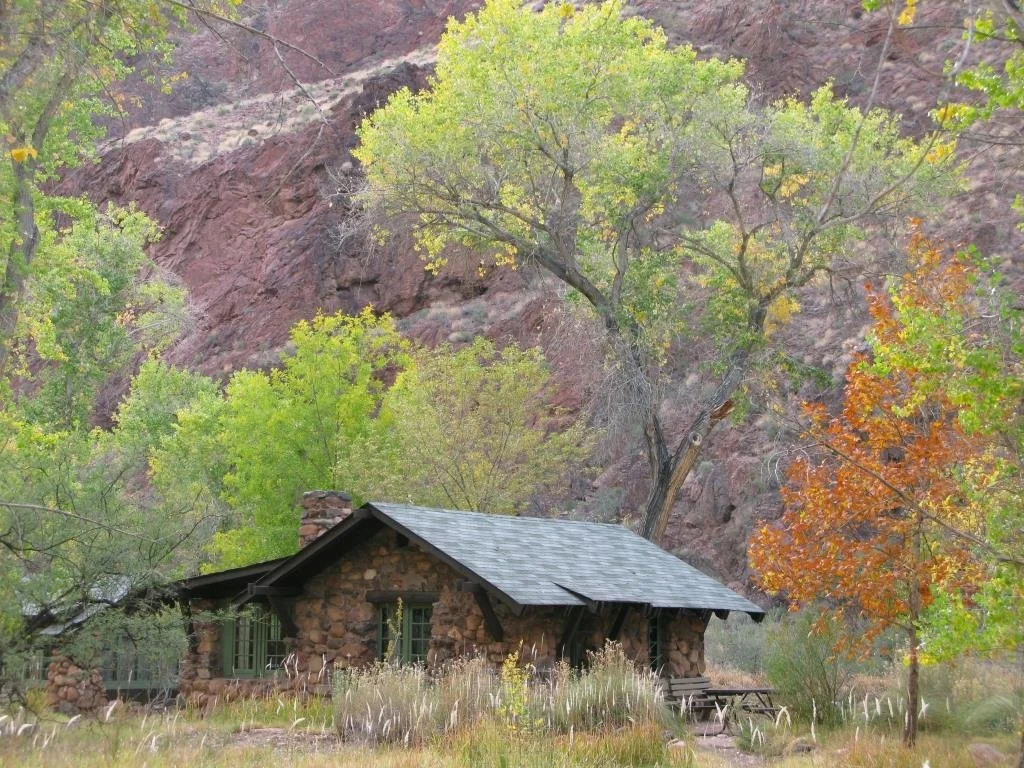
A cabin at Phantom Ranch. NPS/Michael Quinn (0630), 2008.
In 1922, the Phantom Ranch consisted of three cabins with sleeping porches, a caretaker’s cabin, and a dining and kitchen building. By 1928, the Atchison, Topeka, & Santa Fe Railway had expanded the complex with eight additional stone and frame cabins, four tent cabins, a recreation building, and a number of accessory buildings. The resort was operated by Colter’s employer, the Fred Harvey hospitality company.
As late as February 1922, just four months before Phantom Ranch opened, a newspaper referred to the construction underway as “Roosevelt Chalet.” This name came from the resort’s proximity to “Roosevelt Camp” where Theodore Roosevelt had stopped in 1913 while on his way to hunt cougars on the north rim.
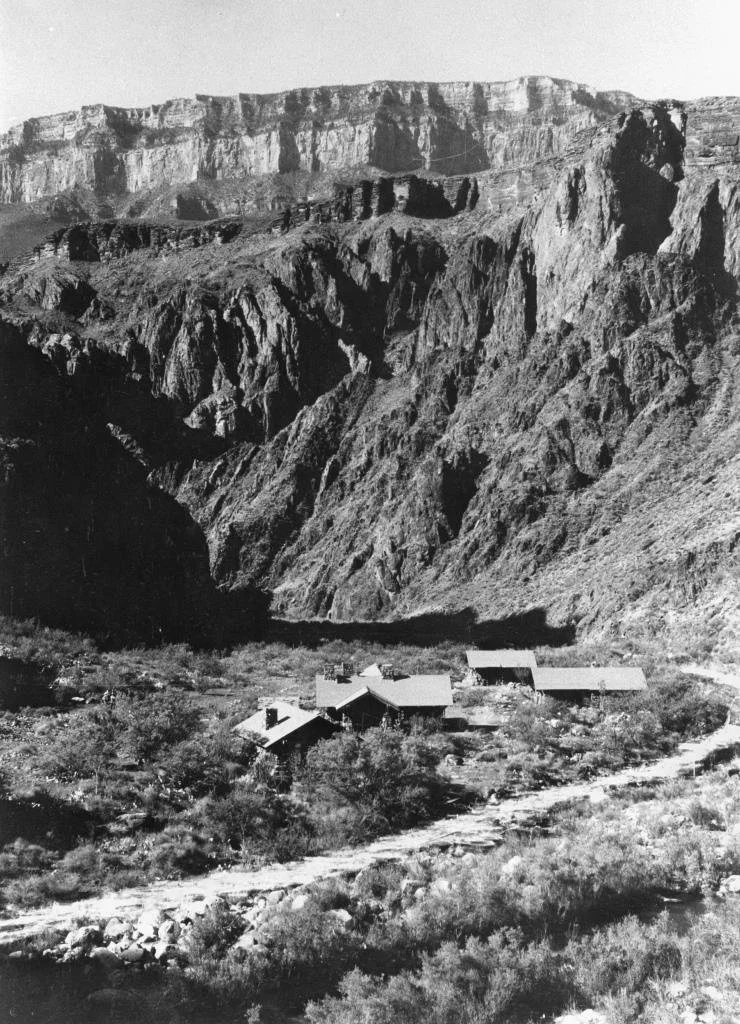
Phantom Ranch, c. 1922. Fred Harvey, NPS/10059 Grand Canyon Museum Collection.
Fred Harvey ultimately opened the camp under the less political, more romantic name “Phantom Ranch.” Mary E. J. Colter is credited with giving the resort this name. There are different theories on how she came up with it. One is the resort’s proximity to Phantom Creek and Phantom Canyon, named by cartographer Francois E. Matthes in 1902. The side canyon was so narrow and twisting it was nearly impossible to chart its topography, with contour lines overlapping to the point that the canyon disappeared on paper. Another theory is the name was chosen because of the reported sightings of a ghost, described in a newspaper as “‘white as all phantoms are and [it] has something of the shape of a veiled human figure….’”
Whatever its origins, the name stuck. Visitors have been enjoying the “atmosphere of unreality” of Colter’s Phantom Ranch for more than a hundred years now.
Please subscribe to The Architectress.
Sources:
Atchison, Topeka, and Santa Fe Railway, “Grand Canyon Outings,” 1927.
Lewis R. Freeman, The Colorado River: Yesterday, To-day and To-morrow (New York: Dodd, Mead and Company, 1923).
Ronald W. Johnson and Tony Crosby, “National Register of Historic Places Inventory—Nomination Form: Cross Canyon Historic District” (draft), February 7, 1980, Item 7, 3, GRCA 96618, Grand Canyon Museum Collection.
“News from Grand Canyon National Park,” Williams News (Arizona), February 17, 1922: 1.
Linda Reeder, “Case Studies in Resource Efficiency: Design and Construction in the Grand Canyon, 1921 – 28.” Construction History: International Journal of the Construction History Society, 2019 (Vol. 34, No. 1), 21-42.
Elizabeth J. Simpson, “Recollections of Phantom Ranch,” Grand Canyon Natural History Association, n.d., GRCA 75347, Grand Canyon Museum Collection.
Betty Leavengood, Grand Canyon Women: Lives Shaped by Landscape. Boulder: Pruett Publishing Company, 1999.
Scott Thybony, Phantom Ranch Grand Canyon National Park. Grand Canyon, Arizona: Grand Canyon Association, 2001.
Terri A. Cleeland, The Cross Canyon Corridor Historic District in Grand Canyon National Park: A Model for Historic Preservation. A Thesis Submitted in Partial Fulfillment of the Requirements for the Degree of Master of Arts in Anthropology, Northern Arizona University. August 1986.
Arnold Berke, Mary Colter: Architect of the Southwest. New York: Princeton Architectural Press, 2002.