Isabel Roberts, Architect Recommended by Wright
Isabel Roberts (1871 – 1955) spent much of her professional career in Florida where, with Ida Annah Ryan, she designed residential, civic, and commercial buildings. Born in Missouri and raised in Indiana, Roberts studied architecture in New York City for three years in a studio modeled after those at the Ecole des Beaux Arts. After completing her education, Roberts moved to Illinois and worked for a series of firms as a drafter. In 1901, Roberts joined Marion Mahony as the second woman in Frank Lloyd Wright’s practice.
Although Roberts held a key role in several of Wright’s projects—including in the design of a house for herself and her mother—Wright was not known for sharing credit. He described Roberts as his bookkeeper and babysitter, leading subsequent historians to document this as her role. While it is possible that Roberts performed these tasks as well as drafting and design, it was not all she did. When Wright left Oak Park for Europe in 1909, Roberts was one of the designers he entrusted to finish the work of his office. In 1920, Wright wrote a letter of support that was submitted with Roberts’ application to American Institute of Architects (AIA). Wright stated, “Miss Isabel Roberts was my assistant in the practice of Architecture for several years and I can recommend her without reservation to anyone requiring the services of an Architect.”
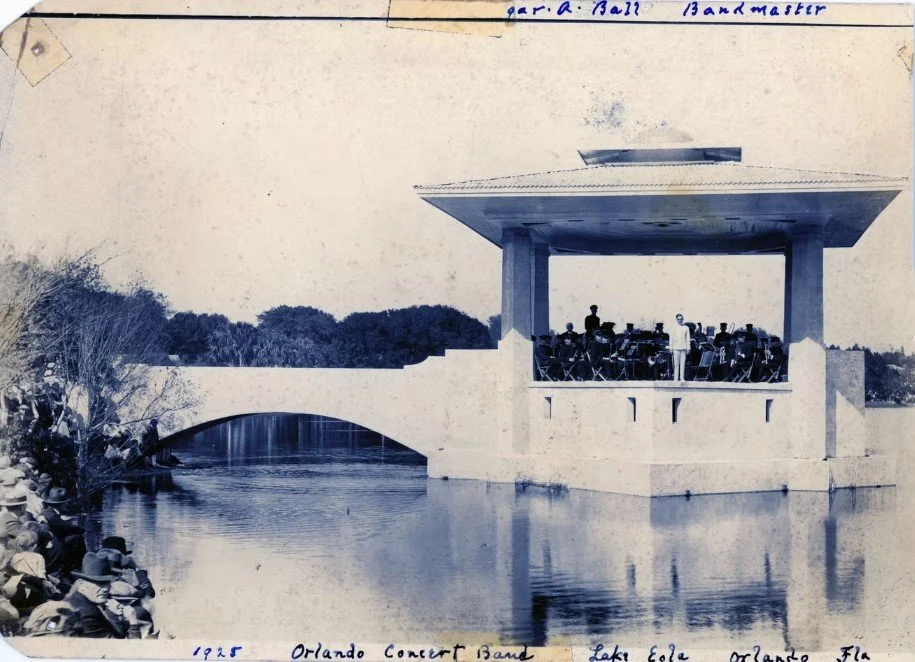
Lake Eola Bandstand, 1925
After closing Wright’s office and working for another former employee of Wright’s in Chicago, Roberts and her mother relocated to Florida in 1916. In 1920, after her ailing mother died, Roberts started a firm with Ida Annah Ryan. Both women applied to the AIA for membership; both were held to a higher standard of membership than the organization’s bylaws required. Ida Annah Ryan, who had been denied membership three times when applying in Massachusetts more than a decade earlier, was admitted to the AIA in 1921 as the organization’s eighth female member. Although many of the men Roberts had worked for and with over the years wrote letters attesting to her qualifications, Roberts was rejected on the grounds that she was not licensed as an architect. One of her recommenders noted his acquaintance with a number of male AIA members who were also not licensed.

Bandstand postcard, c. 1924: (State Archives of Florida)
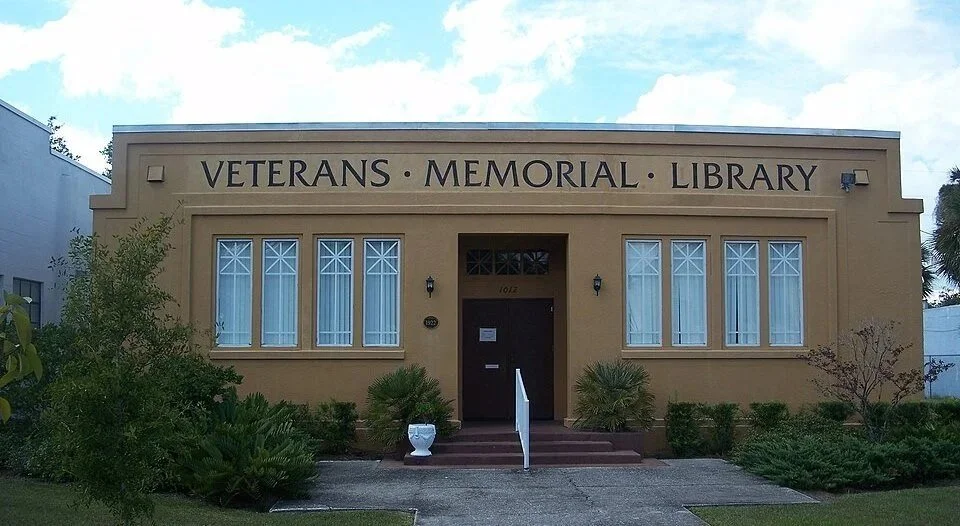
The firm Ryan and Roberts was located in a house that the women designed for themselves in downtown Orlando. In 1922, the St. Cloud Ladies’ Improvement Club awarded the firm the commission for the town’s Veterans Memorial Library. Other projects included a church, a school, houses, and apartment buildings, but the firm was perhaps best known for a bandstand in Eola Park in Orlando. It was awarded this commission in as a result of a competition. The bandstand, which was completed in 1924, sat on the lake itself and had Prairie Style elements.
An economic slowdown hit Florida before the 1929 stock market crash, resulting in Ryan and Roberts earning few significant commissions after about 1927. In 1929, Ryan gave up her hard-won AIA membership to save money.
When Ryan fell ill, Roberts cared for her in their home until Ryan’s death in 1950. Roberts died in 1955. The Eola Lake Bandstand was demolished in 1956.
Please subscribe to The Architectress.
Sources:
Sarah Allaback. The First American Women Architects. Urbana: University of Illinois Press, 2008.
Orlando Foundation for Architecture, “Isabel Roberts & Ida Annah Ryan,” March 23, 2021.
David Rifkind, “Isabel Roberts,” Pioneering Women of American Architecture.
AIA Historical Directory of American Architects, “Isabel Roberts.”