The Dedication of the Desert View Watchtower
In the early 1930s, Fred Harvey architect and decorator Mary E. J. Colter (1869-1958) spent much of her time at the Grand Canyon where she observed the construction of the rest house and observatory she had designed. The tower was located 25 miles from the railroad depot at a high point on the canyon’s south rim.
Colter had integrated architectural elements from Ancestral Pueblo heritage sites into the Desert View Watchtower’s design and commissioned Hopi artist Fred Kabotie to paint murals related to Hopi ceremonies on the tower’s second floor. Representing the indigenous cultures of the region was important to Colter. It was also important to her employer.
One reason Fred Harvey and its railroad collaborator the Atchison, Topeka & Santa Fe were interested in connecting its buildings to the region’s peoples was the marketing potential. The myth of the “Vanishing Indian”—the erroneous belief that Indigenous people would become extinct in the U.S. owing to federal policies and assimilation—drew tourists eager to see them before that inaccurate forecast came to pass. With greatly reduced visitors and passengers owing to the Great Depression, the companies needed to maximize publicity and thereby travelers.
Although construction of the Watchtower finished in November 1932, the Santa Fe Railway’s advertising department suggested postponing the opening celebration until May 1933 for marketing purposes. Some two thousand guests attended the dedication. The guests included several hundred Hopi, Navajo, and Supai people from the Grand Canyon region as well as the governor of Arizona, leaders of the state’s chambers of commerce, ethnologists, and numerous reporters and photographers. The day’s events were widely reported across the nation.
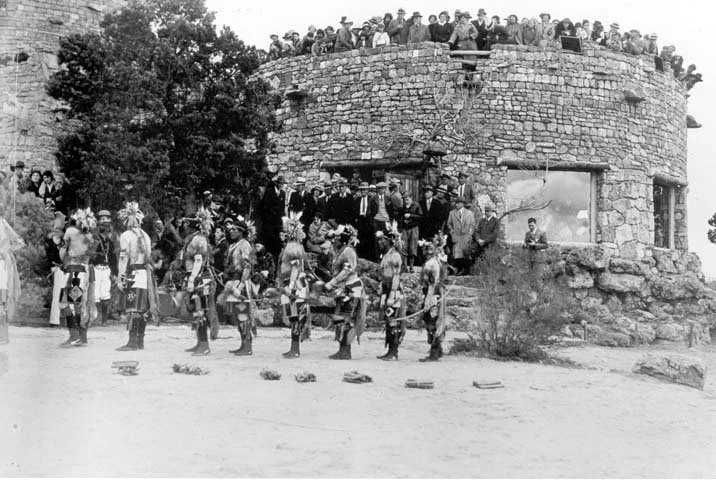
Hopi men dancing at the dedication, with guests watching from the kiva roof (NPS/Fred Harvey, 05425 Grand Canyon Museum Collection)
The participation of Hopi people was integral to the day’s events. The Fred Harvey organization had enlisted the help of Hopi artist Kabotie and Hopi leader Peter Nuvasma to organize a group of Hopi to perform dances. Other Hopi people prepared food or came as spectators.
The Desert View “Blessing of the Kiva” ceremony was believed to be the first performed outside of the Hopi villages on the Second Mesa some distance to the east. Less well-publicized than the Blessing of the Kiva ceremony itself was that it was the second of three different ceremonies. The first was held entirely in secret, away from the eyes of outsiders. Mary E. J. Colter was the only white person invited to the ceremony held before the opening dedication, according to author Frank Waters’s account.
Please subscribe to The Architectress.
Sources:
Frederick W. Witteborg, February 7, 1978 letter to Virginia Grattan, 2, Virginia Grattan Collection, Special Collections, University of Arizona Libraries, Tucson.
“Hopi Dedicate Watchtower at Grand Canyon Tomorrow,” Coconino Sun, May 12, 1933, 1.
“Indian Watchtower is Consecrated by Hopis in Colorful Ceremony,” Coconino Sun, May 19, 1933, 1.
M. R. Tillotson to V. Patrasso, Manager, El Tovar Hotel, April 26, 1933, Series 34 Box 65 f 3/3 D3415 Fred Harvey 1932-38, RG79, Riverside: National Archives.
Fred Kabotie and Bill Belknap, Fred Kabotie: Hopi Indian Artist (Flagstaff: The Museum of Northern Arizona with Northland Press, 1977): 50.
“De-Ki-Veh,” program for May 13, 1933 dedication at Desert View, 1, Box 40 Folder 3, NAU.MS. 280, Fred Harvey Company Records, 1899-2018, Special Collections and Archives, Cline Library, Northern Arizona University, Flagstaff.
Frank Waters, Masked Gods: Navaho and Pueblo Ceremonialism, 2nd ed. (Athens: Swallow Press / Ohio University Press, 1950): 111.