Gertrude Sawyer, Architect and Seabee
When a young Gertrude Sawyer (1895-1996) told her father she wanted to be an architect, he discouraged her owing to her gender. He feared “no one would trust a woman with building a house—the roof might fall in,” she recollected. But Sawyer persisted, eventually establishing a successful Washington, DC residential practice, earning her architectural license in five states, and working for the US Navy’s Civil Engineering Corps during World War II.
When Sawyer reached college age, as a compromise with her father, she studied landscape architecture at the University of Illinois. She received her Bachelor of Science degree in 1918 and went on to study town planning in Cambridge, Massachusetts. But she still wished to be an architect. A newspaper later reported she prevailed after “a bombardment of letters home pleading for a chance to achieve her heart’s desire finally won her father’s consent.” Sawyer earned her master of architecture degree at the Smith College Graduate School-affiliated Cambridge School for Architecture and Landscape Architecture in Massachusetts in 1922.
After earning her master degree, Sawyer worked for less than a year as a draftsman for a Kansas City, Missouri firm before moving to Washington, DC to join the office of Horace W. Peaslee in 1923. After about four months, her title there changed from Draftsman to Associate Member. Like Sawyer, Peaslee had studied both architecture and landscape architecture. They likely met when Peaslee was a visiting instructor and Sawyer a student in landscape architecture at the University of Illinois from 1914 to 1916.
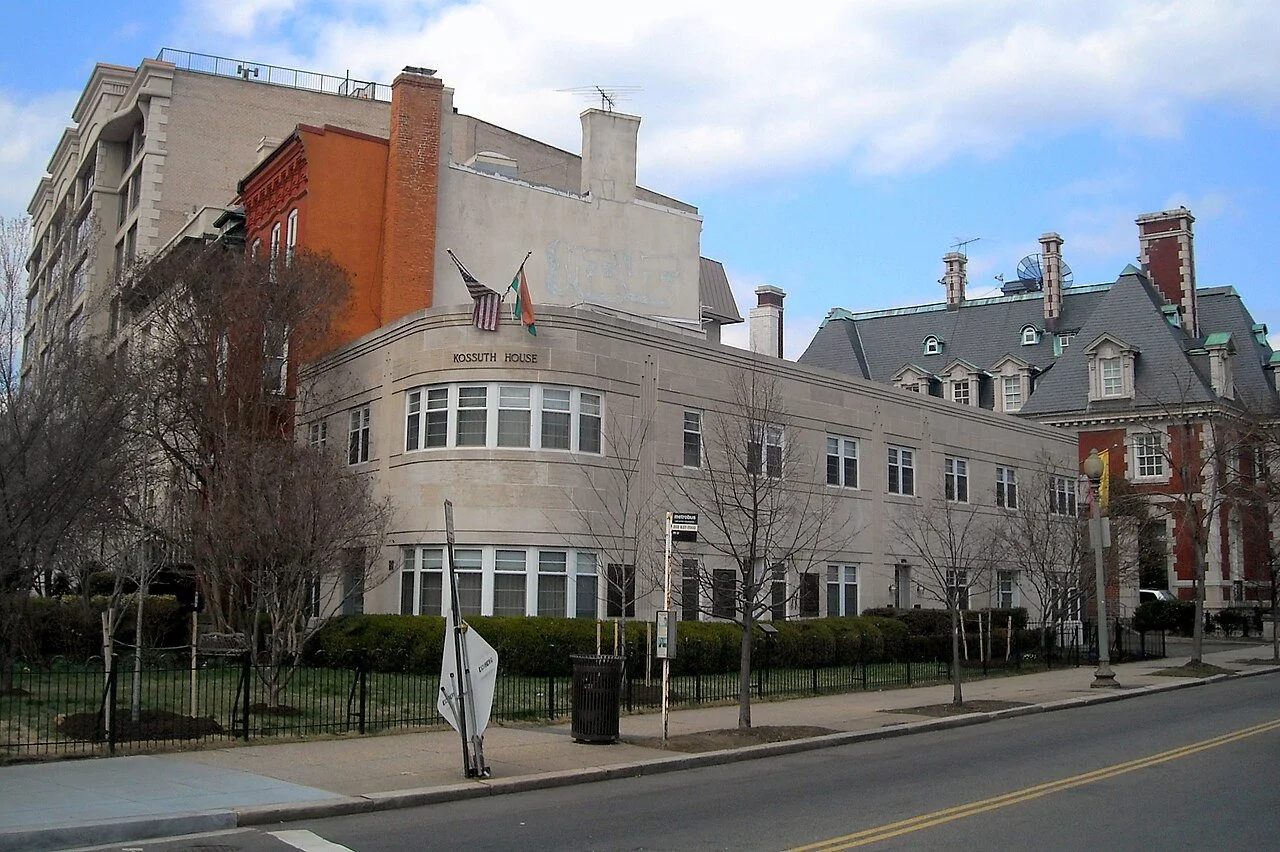
Former Apartment Building (Kossuth House, AgnosticPreachersKid, 2009, CCA 3.0)

In 1932, US State Department diplomat Jefferson Patterson hired Sawyer to design Point Farm, his 512-acre property in Maryland. Sawyer continued to work on Point Farm until 1955. In 1934 Sawyer opened her own practice. She concentrated on residential projects. In 1935, she designed a three-unit Streamlined Moderne apartment building on Dupont Circle in Washington (pictured). It was converted to use as the Junior League Headquarters soon after completion.
In addition to the luxurious homes Sawyer designed in the DC metropolitan area, she also designed country estates farther afield. In 1939, Sawyer became a member of the American Institute of Architects. At that time she was registered as an architect in Washington, DC and four states: Maryland, Florida, Ohio, and Pennsylvania.
When asked in 1956 if she had experienced any discrimination owing to her gender, Sawyer told the reporter, “[P]eople who don’t want a woman architect just don’t come to you. But others see the advantage of your being able to interpret their individual needs because you are a woman.”
At the beginning of World War II, Sawyer closed her practice and went to work for Fairchild Aircraft’s engineering department in Maryland. When the US Navy needed to house 14,000 WAVES (women volunteering in the US Naval Women’s Reserve) in DC, it sought female designers to meet their needs. Sawyer volunteered to work with the Civil Engineer Corps. Most of her work was adapting building interiors for use as temporary homes for the women.
Sawyer reopened her practice after the war. She worked primarily in Washington, DC until her retirement in 1969. Gertrude Sawyer died in Los Angeles, California in 1996 at age 100.
Sources:
“Gertrude Sawyer,” AIA Historical Directory.
Ruth Dean, “For the Seabees: Woman Architect Came to their Aid,” The Sunday Star (Washington, DC), March 25, 1956: D-10.
Sarah Allaback, The First American Women Architects (Urbana and Chicago: University of Illinois Press, 2008).
SAH Archipedia, “Kossuth House.”
R.R. Bowker LLC, “Gertrude Sawyer,” 1956 American Architects Directory.
National Park Service, “Horace Peaslee.”