Inequity at Home Feeds Gender Pay Gap
On average, women spend about 50 percent more time on daily household tasks as compared to men while working only 14 percent less outside the home. This gender disparity contributes to the gender pay gap.
Males in the US spent an average of 1.58 hours per day on household activities in 2025, as compared to 2.38 hours for females, according to the US Bureau of Labor Statistics (BLS). That is, women on average spent 48 minutes (50 percent) more time than men each day on household tasks like cleaning, cooking, yardwork, pet care, car maintenance, etc. In households with children or others requiring care, the care was also disproportionately provided by women, with men averaging 1.9 hours per day, while women averaged 2.5 hours, according to the BLS.
In an interview with Behavioral Science, economic historian and author Claudia Goldin says closing the gender wage gap cannot be done by the workplace alone. When couples have children or other care responsibilities, “the price of equity can be the difference between two earnings scenarios: one person in a couple taking the higher paying, less flexible, and ‘greedier’ role, while the other partner takes a more flexible, lower paying one,” Goldin says, “And the other scenario is one in which both forgo higher earnings, and take more flexible work.” Often the woman takes the lower-paying job to accommodate care responsibilities. But on average, even when women work fewer paid hours, their total hours worked (paid and unpaid) still exceed those of men.
Inequality at home also holds women back at work. Goldin says, “[I]t may be very hard for us to put the blame on decisions that we make with our spouses, or on society for having expectations that we as women are the ones who are the caregivers….[T]he most important negotiating as an adult we can do as women is with our spouse.”
How we can Address Inequality at Home and at Work:
Co-habitating Partners:
Track actual (not perceived) minutes worked in both paid and unpaid work each week, and negotiate a more equitable existence. In addition to minutes spent, consider how onerous the tasks are; most people enjoy playing with their kids more than scrubbing toilet bowls or vacuuming, and this should figure into the negotiations.
Consider the second scenario Goldin mentions: the option of both partners taking jobs that are more flexible instead of having one partner sacrifice her career.
If your job lacks flexibility, advocate at work for more flexibility for all whenever possible.
Parents:
“Gender inequality in pay begins at home, and early in life,” the New York Times reported. Boys age 15 to 19 spend one-third less time on household chores yet earn higher allowances than their sisters. Give your sons and daughters chores taking equal time, and pay them equally—or if age differences make this impractical, prorate an equal hourly rate for time spent.
Boys need to be trained to do unpaid tasks in order to contribute equally when they are adults. In additions to requiring children to contribute equitably to household chores. regardless of gender, adult men need to be good role models and participate equally
See “How to Raise a Feminist Son” for ideas to help boys buck gender stereotypes.
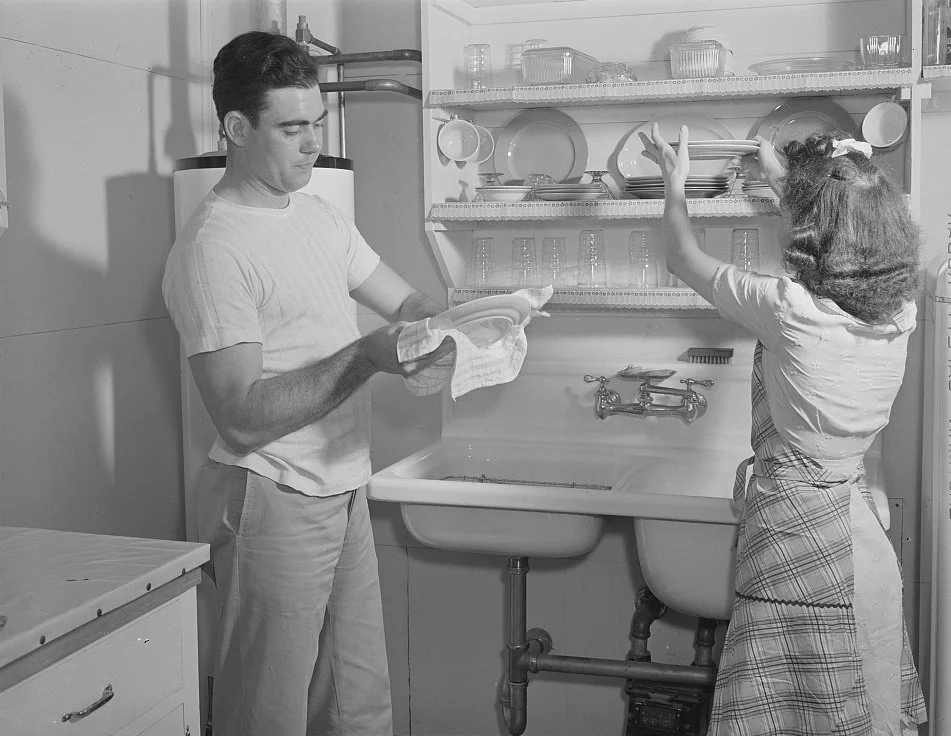
John Collier, Jr, 1942 (Library of Congress)
Government and Institutions
Institute government programs that support equity in families, like paid family leave and subsidized child- and elder-care.
Schools and daycares can contact fathers first when they need to reach a parent.
Please subscribe to The Architectress.