Gunnar Widforss Painted Mary E. J. Colter’s Watchtower
Architect and decorator Mary E. J. Colter (1869 – 1958) spent weeks or months at a time at the Grand Canyon during her more than forty years working with the Fred Harvey hospitality company. Between 1904 when she helped decorate the Hopi House and her retirement in 1948, Colter designed rest houses, hotels, worker dormitories, a resort, an observation tower, and the renovation or redecoration of other projects. She also worked with the National Park Service on park planning.
During her time at the Grand Canyon, Colter naturally became acquainted with locals, colleagues, and others. Artists were among those drawn to the canyon’s beauty. Some were introduced to it by the Atchison, Topeka, and Santa Fe Railway. The Railway’s promotional efforts included bringing artists to the Grand Canyon and other attractions in exchange for the use of one of the works they produced there. Thomas Moran was an early participant of this program. A color lithograph of one of his paintings allowed the Santa Fe to bring the Canyon’s many colors to viewers who had only seen the Canyon in black and white photographs, if at all.
Swedish-born watercolor artist Gunnar Widforss (1879 – 1934) took a different path. He became enamored with the American West when he toured the US from 1905 to 1908. He immigrated to the US in 1921, first settling in San Francisco and then traveling among different Western national parks. Widforss painted detailed realistic scenes drawn from nature. A talented artist, he seemed content to earn just enough to support his continued work in the parks; the business side of art-making was not a priority.
After the Great Depression began, it became more challenging for Widforss to eke out a living. He spent much of the early 1930s at the Grand Canyon where he made friends with a number of locals. Widforss had become a naturalized US citizen, and a Works Project Administration grant provided him with some support. Fred Harvey sold some of his paintings at El Tovar. When Widforss wasn’t staying with friends, he lived in a Fred Harvey employee dormitory and paid for his room and board when he sold paintings.
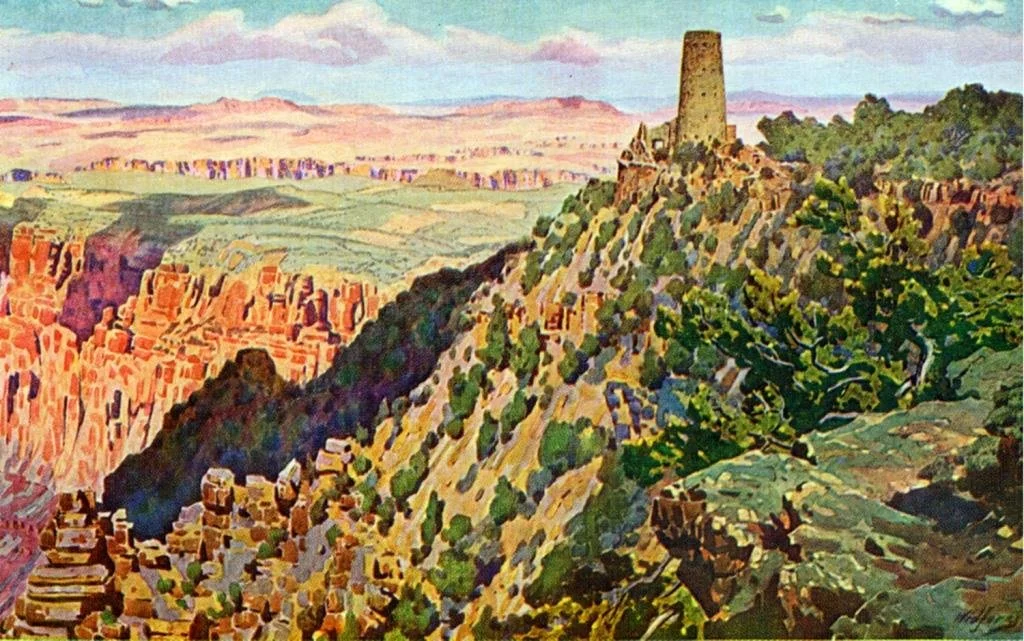
NPS/Fred Harvey, H4483 Grand Canyon Museum Collection.
When Widforss fell behind in his payments, a Fred Harvey executive in Chicago suggested that he make quick sketches to sell for $25 to $35, as compared to his typical meticulously detailed paintings that commanded $75 to $400 but were slow to sell. Widforss initially complied and the quicker, lower-priced paintings sold well. But Widforss was not satisfied with the quality of these paintings and soon stopped making them.
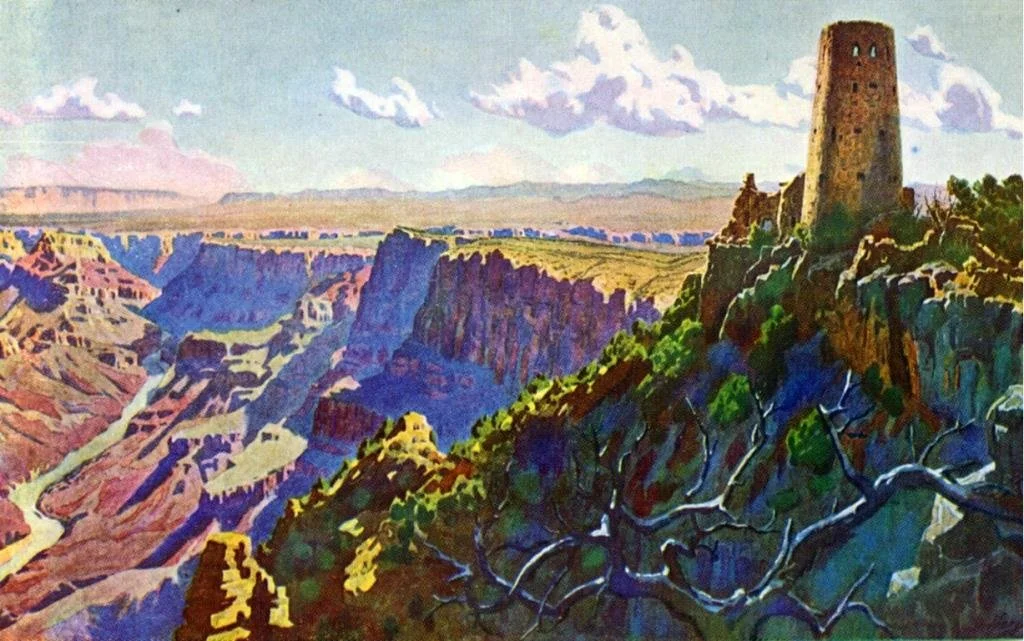
NPS/Fred Harvey, H4481 Grand Canyon Museum Collection
Like Widforss, Colter spent many weeks at the Grand Canyon in the early 1930s. There she supervised construction of the Desert View Watchtower. At the end of each day, Colter returned to her hotel in Grand Canyon Village and drafted a telegram describing what she had observed on the construction site. Twelve hundred miles away in his Kansas City office, Colter’s supervisor John F. Huckel updated his model of Colter’s tower design to reflect the progress she reported.
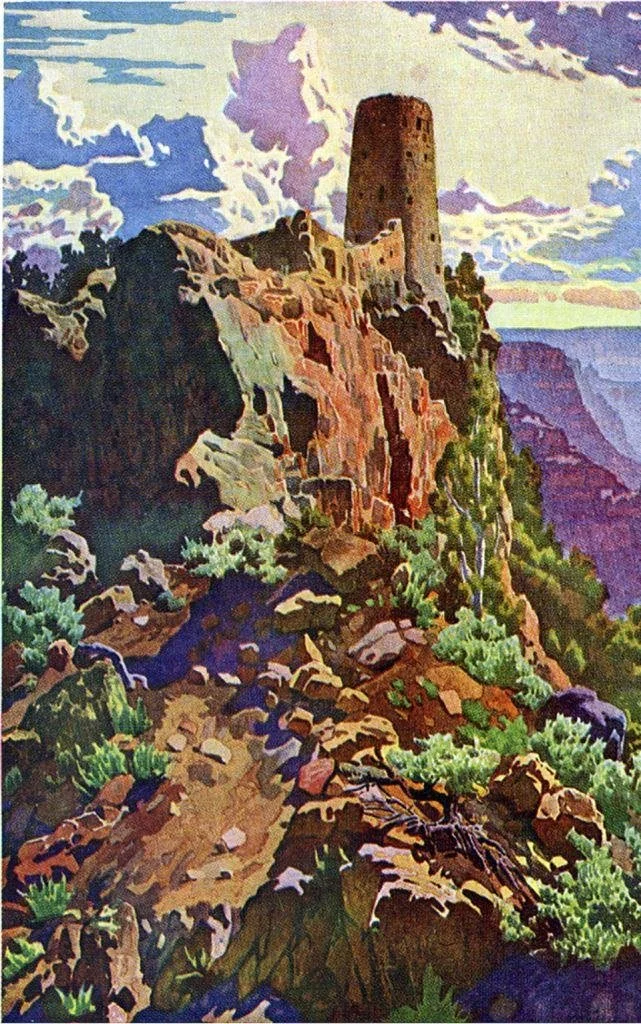
NPS/Fred Harvey, H4480 Grand Canyon Museum Collection
The Watchtower project was significant to Fred Harvey in part because it was geared toward visitors in automobiles, a departure from relying on now-dwindling train traffic. The organization heavily promoted the opening of Desert View Watchtower in May 1933. Part of the promotional efforts included a set of post cards with watercolors of the Watchtower painted by Widforss. This series of paintings, while conveying Widforss’s talent and capturing the Watchtower’s appearance and surroundings, show less detail than his typical paintings. You can see some of his more detailed work here. It is entirely possible that these paintings of Colter’s Desert View Watchtower were created during Widforss’s short-lived attempt at making quick watercolor sketches. There is much to admire about them, even if they fell short of Widforss’s high standards.
Widforss died of a heart attack in 1934, at the Grand Canyon. He was memorialized in the canyon he loved when “Widforss Point,” a 7,800 foot high peak on the north rim, was named for him.
Please subscribe to The Architectress.
Sources:
Bill Belknap and Frances Spencer Belknap. Gunnar Widforss: Painter of the Grand Canyon. Flagstaff: Northland Press for the Museum of Arizona, 1969.
Sandra D’Emilio amd Susan Campbell. Visions and Visionaries:The Art & Artists of the Santa Fe Railway. Salt Lake City: Gibbs Smith Publisher, 1991.
Gunnar Widforss Biography, CaliforniaWatercolor.com.
F. W. Witteborg, typescript accompanying letter to Virginia L. Grattan, February 7, 1978, MS 656 Box F2, Virginia Grattan Collection, Special Collections, University of Arizona Libraries.