Mary E. J. Colter on Trains, Planes, and Automobiles
Artist, teacher, decorator, and architect May E. J. Colter (1869 – 1958) was born at a time when “car” referred to a train carriage. She was a frequent train passenger. In the first eleven years of Colter’s life, her family moved from Pittsburgh to Saint Paul (Minnesota), Texas, Colorado, and back to Saint Paul. As a young woman, Colter traveled to California to attend art school before returning to Saint Paul via a six-month teaching stint in Wisconsin.
Colter’s wanderlust continued even as she settled into a 16-year teaching career in St. Paul, with trips to Seattle, Albuquerque, and (no doubt) other locations. In 1910, Colter’s opportunities to travel expanded. That was the year she began working full-time for the Fred Harvey hospitality company. Fred Harvey managed the restaurants, hotels, newsstands, and other concessions along the Atchison, Topeka, & Santa Fe Railway’s routes, and Colter frequently traveled among these properties.
In addition to her many miles of train travel, Colter also traveled by automobile. In the early decades of the 20th century, she was among the roughly 2 percent of Americans who owned a car. A secretary at Fred Harvey headquarters in Kansas City remembered people asking after Colter’s Buick. “I believe she named it the ‘Blue Ox,’” Zelma V. Fowler recalled.
In researching her design for the Desert View Watchtower at Grand Canyon in the early 1930s, Colter spent six months traveling to Ancestral Puebloan heritage sites in the Southwest studying ancient structures, masonry patterns, and other architectural elements. Travel to the heritage sites was slow and often jarring, and there were few hostelries, stores, telephones, or telegraphs along the way. Although Colter enjoyed the creature comforts and fine dining offered by the Fred Harvey hotels and restaurants she usually experienced during her travels, she willingly “roughed it” to visit the remote heritage sites.
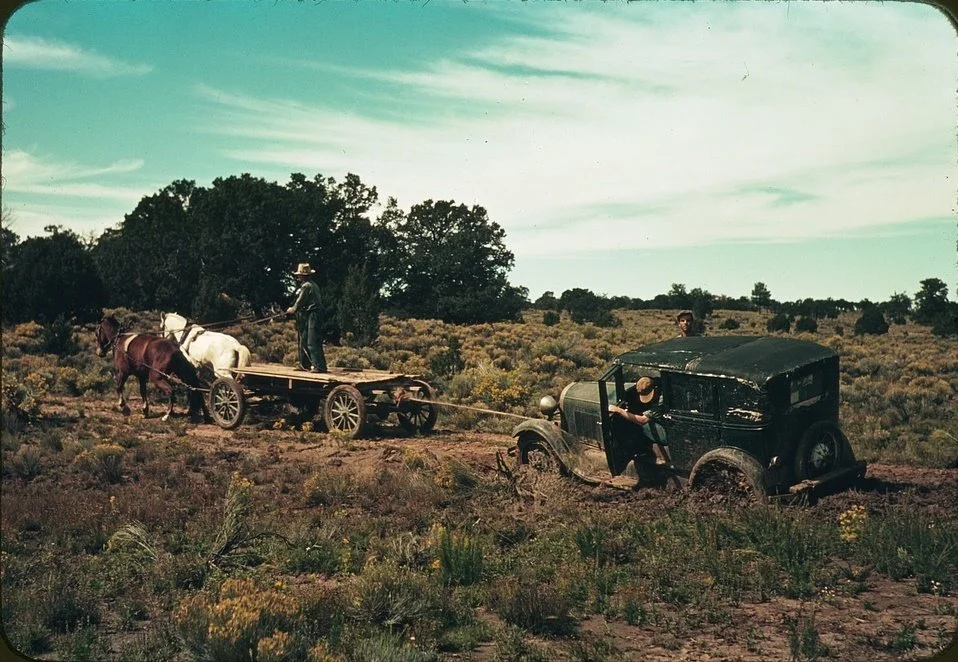
Near Pie Town, NM, 1940. Photo by Russell Lee (Library of Congress)
Owing to the poor road conditions, Colter left the driving to one of the professionals employed by Fred Harvey. In addition to driving and navigating skills, the drivers had to have mechanical skills. Archeologist Ann Axtell Morris, who travelled to many of the same sites as Colter in this era, listed items required for motor travel in the Southwest to include, in addition to water and camping gear, “extra gas, extra oil, an axe, a shovel, flashlights,…chains for all four wheels, tools, spare tires—everything almost except an extra carburetor….”
In addition to her adventures by car, an acquaintance recalled Colter as being “sufficiently adventurous to fly over the country of Northern Arizona and Southern Utah in a private plane” to look at the prehistoric structures from the air during the early years of aviation.
Please subscribe to The Architectress.
Sources:
Zelma V. Fowler, letter to Virginia Grattan, March 1, 1978. MS 656 Box F2, Virginia Grattan Collection. Special Collections, University of Arizona Libraries, Tucson.
Ann Axtell Morris, Digging in the Southwest. Garden City, NY: Country Life Press, 1933.
Arnold Berke, Mary Colter: Architect of the Southwest. New York: Princeton Architectural Press, 2002.
Dagget Harvey, letter to F. A. Tipple, September 1, 1976, 1, Box 1, Folder 6, Fred Harvey papers, 1858-1990, Fra Angelico Chavez History Library, New Mexico History Museum, Santa Fe.
Mary Elizabeth Jane Colter, Manual for Drivers and Guides: Descriptive of The Indian Watchtower at Desert View and its Relation, Architecturally, to the Prehistoric Ruins of the Southwest. Grand Canyon National Park: Fred Harvey, 1933.